How to Choose the Best Commercial Cleaner for Your North Shore Milwaukee Business

A clean building rarely gets praise when everything is going right. People notice when it goes wrong: sticky floors, dusty vents, overflowing trash, streaked glass, restroom odors, or salt tracked across an entryway in February.
For a North Shore Milwaukee business, the right commercial cleaner protects more than appearances. It helps preserve flooring, keeps shared spaces more pleasant, supports staff morale, and gives customers one less reason to question the quality of the operation.
The hard part is knowing which cleaning company can actually deliver. Many providers sound similar at first. They all promise reliability, attention to detail, and flexible service. The difference shows up in the questions they ask, the clarity of their proposal, and how they handle the small issues that happen in real buildings.
This guide walks through what to look for before signing a cleaning contract, from scope and scheduling to insurance, quality checks, and red flags.

Start with the kind of cleaning your building actually needs
Before comparing companies, get clear on the work itself. A general promise to “clean the building” leaves too much room for different expectations.
A small medical office, a retail shop, a church, a fitness studio, and a professional service firm may all need cleaning, but not the same cleaning. Traffic levels, floor types, restrooms, food areas, public access, and operating hours all matter.
Start by listing the spaces that need regular attention:
Entrances and vestibules
Restrooms
Break rooms or kitchenettes
Waiting areas
Hallways and stairs
Workspaces and shared tables
Floors, carpets, and hard surfaces
Interior glass and doors
Trash and recycling areas
Supply closets and storage zones
Then separate daily needs from weekly, monthly, and seasonal work. This is where many contracts become either too vague or too expensive.
Daily or frequent tasks often include trash removal, restroom cleaning, touchpoint wiping, floor care, and entryway maintenance.
Periodic tasks might include carpet cleaning, machine scrubbing, high dusting, interior window cleaning, floor refinishing, or deep cleaning after events.
North Shore properties also deal with seasonal cleaning challenges. Winter salt and slush can scratch floors and leave white residue. Spring brings mud and pollen. Summer may increase foot traffic in retail and hospitality settings. Fall leaves and damp conditions can make entryways harder to maintain.
A good cleaning company should ask about these details before sending a quote. If they give a price without walking the space or asking specific questions, that is a warning sign.
Compare companies by process, not promises
Most cleaning providers can say the right things. The better question is how they prove those things in practice.
When speaking with a potential provider, listen for clear answers about process. Who cleans the building? Who supervises the work? How are tasks documented? What happens when someone is absent? How are complaints handled?
A reliable provider should be able to explain:
How cleaners are trained
Whether the same crew will service the account
How replacement staff are handled
What products and equipment they use
How quality checks happen
How often management visits the site
How communication is documented
This matters because cleaning is repetitive work. Quality depends on systems, not just good intentions.
Ask whether the company uses a written scope of work. This should spell out each task and how often it will be done. For example, “clean restrooms” is too broad. A better scope says whether the team disinfects fixtures, wipes partitions, restocks supplies, empties trash, cleans mirrors, spot-cleans walls, and mops floors.
The same applies to floors. “Clean floors” might mean vacuuming, dust mopping, damp mopping, auto-scrubbing, or spot treatment. Each method serves a different purpose.
If you are comparing bids, make sure each company is pricing the same scope. A lower bid may simply leave out work that another provider included.
What to compare | Why it matters |
Written task list | Prevents confusion about what is included |
Cleaning frequency | Keeps expectations realistic for traffic levels |
Supervision plan | Shows how quality will be checked |
Communication method | Makes it easier to resolve issues quickly |
Supplies and equipment | Affects consistency and surface care |
Special services | Helps avoid surprise costs later |
The best janitorial choice is not always the cheapest. The best choice is the company that can explain exactly what will happen, when it will happen, and how they will make it right if something gets missed.
Check insurance, staffing, and safety practices before price
Price matters, but risk matters too. A cleaning crew may work in your building after hours, around keys, alarm codes, equipment, private documents, merchandise, or customer areas. That makes trust and accountability essential.
Ask for proof of insurance before signing any agreement. At a minimum, a commercial cleaner should carry general liability insurance. Depending on the work and staffing model, workers’ compensation coverage may also apply. Do not rely on a verbal yes. Request current documentation.
Also ask whether employees are company staff or subcontractors. Subcontracting is not automatically bad, but it changes accountability. If a provider uses subcontractors, ask how they are screened, trained, scheduled, and supervised.
Security also deserves a direct conversation. Ask how keys, fobs, alarm codes, and access instructions are managed. A professional company should have a clear policy for access control and a plan for reporting issues such as unlocked doors, leaks, broken fixtures, or unusual conditions.
Safety practices matter as well. Cleaners should know how to handle chemicals, label bottles, place wet floor signs, and use equipment properly. If your building has sensitive surfaces, such as natural stone, wood, specialty flooring, stainless steel, or glass partitions, ask how they prevent damage.
This is especially important for businesses that serve the public. Slippery floors, harsh odors, or poorly rinsed surfaces can create avoidable problems.
A dependable provider should be able to discuss:
Safety data sheets for cleaning products
Proper dilution and labeling
Color-coded microfiber systems where useful
Wet floor signage
Equipment maintenance
Secure storage of supplies
Incident reporting
This is where the terms office cleaning, janitorial, commercial cleaning can start to blur. Some companies focus on basic nightly tasks. Others can handle more complete building care, including periodic deep work and floor maintenance. Match the provider’s capabilities to the building’s real needs.
Ask how quality will be measured after the first week
The first few cleanings are usually the easiest. Everyone is paying attention. The bigger test comes after the account becomes routine.
That is why quality control should be part of the conversation before the contract starts. Ask what happens after the first week, the first month, and the first complaint.
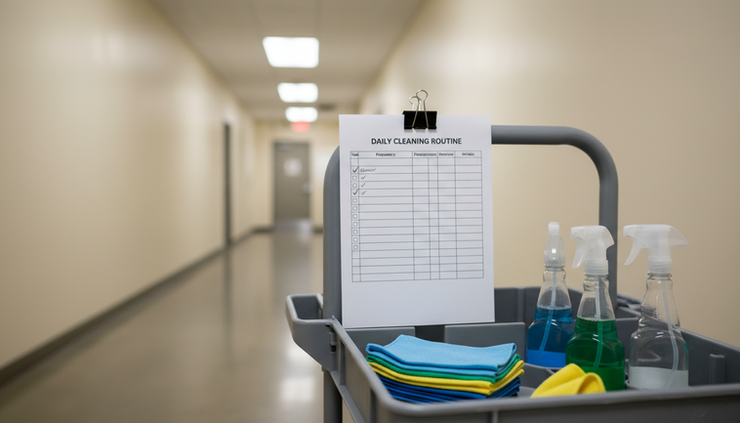
A strong company will not depend on you to notice every problem. They should inspect their own work. That may involve supervisor visits, checklists, photos where appropriate, or scheduled walk-throughs with the client.
Clear communication is just as important as inspections. If there is no easy way to report an issue, small frustrations build up. A missed trash can becomes a pattern. A dusty ledge becomes proof that no one is checking. A restroom supply problem becomes a daily annoyance.
Ask these questions before choosing a provider:
Who is the main contact for service concerns?
How quickly do they respond to missed tasks?
Will the same cleaner or crew handle the building?
How are recurring issues tracked?
Can the scope be adjusted as needs change?
Will they schedule periodic walk-throughs?
A good cleaning company welcomes this conversation. It shows they plan to keep the account, not just win it.
It also helps to set standards that match the building. For example, a busy retail entrance may need more floor attention during winter than during summer. A restroom used by customers may need a higher frequency than a staff-only restroom. A showroom or lobby may need more glass and dust control than a back storage area.
Cleaning quality is not only about effort. It is about matching the level of service to the level of use.

Watch for red flags in the proposal and walkthrough
The walkthrough tells you a lot. A thoughtful provider will look at flooring, restrooms, traffic patterns, trash volume, entry mats, supply storage, and access points. They may ask about business hours, customer flow, problem areas, and past cleaning issues.
A rushed walkthrough often leads to a weak proposal.
Be careful if a company:
Gives a quote without seeing the space
Cannot explain what is included
Uses vague phrases instead of task details
Avoids questions about insurance
Has no clear contact person
Promises unusually low pricing without reason
Cannot describe their hiring or training process
Pushes for a long contract before proving service
Treats special requests as an afterthought
Low pricing can be tempting, especially for a small business. But cleaning companies that underbid often have to cut somewhere. That may mean less time in the building, rushed work, poor supervision, cheap supplies, or frequent staff turnover.
A better proposal will make the service easy to understand. It should include the areas covered, task frequency, schedule, price, special services, supply responsibilities, start date, cancellation terms, and contact information.
Read the details. For example, restroom supplies may or may not be included. Carpet cleaning may be separate. Floor refinishing may have its own quote. Window cleaning may refer only to interior glass within reach.
None of those exclusions are necessarily a problem. Hidden exclusions are the problem.
If the building has unique needs, bring them up early. That might include:
Day cleaning instead of after-hours cleaning
Fragrance-sensitive areas
Green cleaning preferences
High-security zones
Customer-facing cleaning during business hours
Event cleanup
Seasonal floor care
Specialty flooring
Shared tenant spaces
The right provider will tell you what they can handle, what costs extra, and what may require a separate service plan.
Choose the cleaner that fits the building, not just the budget
A good commercial cleaning relationship is practical. The cleaner understands the building, the business understands the scope, and both sides communicate before small issues become large ones.
When comparing final options, look beyond the monthly price. Ask which company gave the clearest answers. Which one noticed details during the walkthrough? Which one explained how they prevent missed tasks? Which one made it easy to understand the proposal?
The right choice usually has a few things in common:
A clear written scope
Proper insurance documentation
A realistic schedule
Trained and supervised staff
Straightforward communication
Fair pricing for the amount of work
Willingness to adjust as needs change
It also helps to start with a defined trial period or early review. After a few weeks, walk the building and compare the results to the scope. Check restrooms, floors, trash areas, touchpoints, corners, glass, and any spots that caused issues before.
If the company responds well to feedback, that is a good sign. If they become defensive or keep missing the same items, the relationship may not improve.

If you are ready to compare options or want a clearer plan for your space, request a commercial cleaning estimate for your building.
A cleaner building starts with a better hiring process. Define the work, ask specific questions, verify the basics, and choose the provider that can show how quality will be maintained after the first impression fades.


Comments